
 Permachar
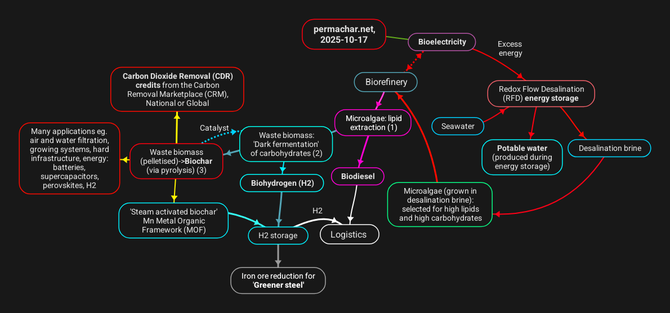
Microalgae for 'Carbon negative'
- bioelectricity
- energy storage
- potable water
- biodiesel
- biohydrogen
- biochar eg.water filtration, Atmospheric Water Harvesting (AWH)->dew irrigation system
- 'Greener steel'
Plus CDR credits (additional revenue stream)
- options for pigments and bioactive compounds using additional microalgae strains
- protein usually uses the whole plant eg. Spirulina
Biochemistry
Photosynthesis of microalgae->carbohydrates->pretreatment with enzymes eg.cellulase->cell wall breakdown->bioavailable carbohydrates(glucose) for bacteria + biochar catalyst->dark
fermentation (DF) of carbohydrates (via at least 2 metabolic pathways)->Hydrogen evolution (production) with Hydrogenase, combining protons and electrons to form molecular hydrogen (but the
reaction is also reversible: H2<->2H+ + 2e-)
NOTES
- Modular and scalable system, mostly solid state (more research needed on the hardware)
- No electricity/unpowered process (for both desalination and H2, other than the seawater pumps) compared to powered desal and electrolysis but maybe more complex workflow, expensive hardware and
lower yields! Also, powered electrolysis can be done using seawater, but most tech of the day use potable water
- pretreatment (before the initial lipid extraction) can be physical, chemical or biological but I prefer biological for it's 'Green chemistry' and energy efficiency
- some naturally occurring microalgae strains perform better than GE strains in brine (halotolerant/halophilic)
- The hunt is finding the best strain that grows in brine, fast growth rate, high in lipids and carbohydrates, preferably endemic and high surface area after Pyrolysis, eg. Nanochloropsis oceanica
- ticks most (?all) the boxes
- genome sequenced
- There is also a possibility of using a different strain of Nanochloropsis, unknown, studied in an academic paper on supercaps (see below), which achieved at Highest Temperature Treatment (HTT) 900degsC during pyrolysis, with KOH activation afterwards, 3187m2/g surface area which is off the charts! This could be a contender for Atmospheric Water Harvesting (AWH) panels but would probably need to be directly pyrolysed with no biorefinery cascade
- surface area will also depend on pretreatment used for biodiesel, protein, biohydrogen and biogas production, and the pyrolysis tech eg. Charcell (https://metamorf.engineering/) (with heat exchanger for bioelectricity), and pyrolysis temperature. Activation also plays in - KOH V steam activation
- A suitable halotolerant bacteria is needed for DF
- The quality of the Biochar is uncertain since cell walls are broken down during pretreatment of microalgae which will decrease surface area, important for catalyst efficiency (and other
applications eg.water filtration, too)
- The biorefinery uses a cascade of microalgae processing: lipid extraction->Biodiesel->Protein->Biohydrogen + Biogas (using DF)-> waste biomass->dried-> pelletised (doped with
?Fe3O4for DF catalyst)->Pyrolysis-> biochar pellets->various applications, with possible steam activation for air and water filtration
- For the DF catalyst: (doped) biochar pellets->steam activated->milled (for huge surface area/microbial habitat)->added to DF process
- For the H2 storage media (biochar Mn MOF):biochar pellets->steam activated->organic linkers and Mn salts added in 'One pot'->Carbon-Oxygen-Metal (C-O-M) bonding->washed->dried->H2 storage tank pellet media for increased volumes of H2 storage, ?more stable at ambient temperature
Both of the above processes need more research!!
- supply and demand of all the products needs to be balanced which will vary from one place/economy to the next
- buffers exist to balance energy
- energy storage (RFD)
- H2 storage
- bioelectricity production (microalgae waste biomass fuel pellets input)
FYI
Try doing an academic 'Research' search in perplexity.ai for:
"Nanochloropsis oceanica: Integrated Biorefinery cascade for Biodiesel, Protein, Biohydrogen, Biogas and Biochar Production in Brine Systems"

Write a comment