
 Permachar
Navigator 'Adapt' TLUD
THE NAVIGATOR 'ADAPT' V1 TLUD STOVE


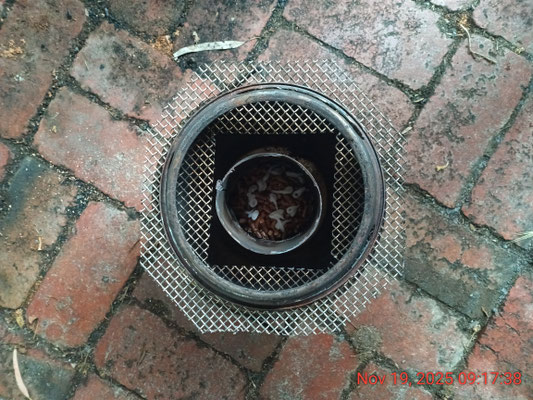
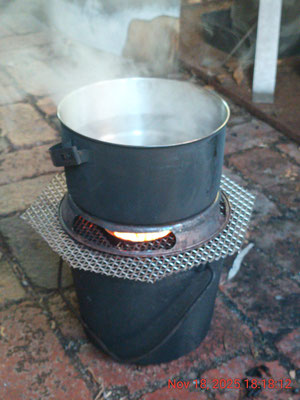
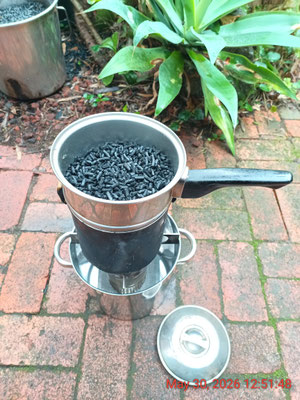
My first prototype of the Navigator 'Adapt' TLUD stove using Tatonka 2.5L cookware for the test bed.
Chance favours the prepared mind. Not pure chance I came up this beauty!
Basically, a miniaturized Navigator 'Awesome' TLUD (original mesh+differently modded wok ring=pot stand) but for a 5L stainless billy (that serves as a quench collector, heat and wind shield, pot stand support plus bonus bucket/stockpot)
- dims
- 100mm/4" wide
- 10/20 primary air slots
- 90 high fuel reactor
- 100/110 secondary air slots
- 70mm chimney
- 180mm high
- pot stand
- 5 x 5 x 1.6mm 304 woven mesh
- stainless wok ring (modded for lateral air slots)
- 400g wood pellet max capacity
- burner weight: 255g
TESTING
400g
-First prototype
1st burn
- ambient temperature: 16degsC
- slight cross breeze
- startup time: 2m
- Tatonka 2.5L cookware (2.5L water)
- t=0, 16degsC
- t=10, 38degsC
- t=15, 52degsC
- t=20, 67degsC
- t=25, 80degsC
- t=30, 92 (lid off)
- t=35, boiling
- t=40, boiling
- t=45, simmering
- t=50, simmering
- t=55, simmering
- t=58, 85degsC
- pasteurization OK! (Reached 71 degsC at <25m)
- Final water temperature: 85degsC
- burn time: 58m
- Biochar recovery: 99%
THE NAVIGATOR 'ADAPT' V2 TLUD STOVE
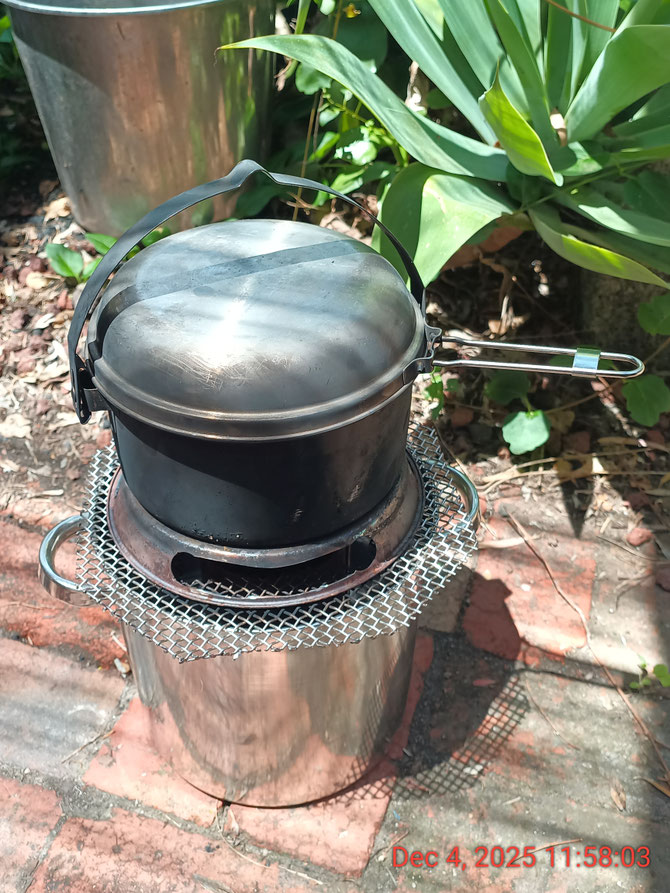
This beauty is going to use the 7.6 litre stainless stockpot which is slightly higher and wider (increased stability) than the 5L stainless billy. The burner is 190mm high (with adequate tertiary
air), dims that were also similar to the Navigator 'Backup' V1 (200mm high) and Navigator 'Backup' V2 (210mm high). It's also cheaper, OTS (no laser cut pot stand), and more stable than the
'Backup' V2. The modded wok ring (lateral air slots) allows larger pots and pans and is super stable. I'm going to use a 60mm chimney and the double rows of both primary and secondary air slots.
I'm also going to build 2 of them to use as a dual burner stovetop eg. curry on one burner and rice on the other burner. There's also a possibility of using one of the stockpots to pasteurize
water on one 'Adapt' before cooking in dual burner mode.
Tech specs:
- 7.6L stainless stockpot
- quench collector, heat shield, wind shield, pot stand support plus bonus water collector eg. Water collection, dishes tub etc.
- dims of the burner
- tube/chimney flue 4"/100mm wide
- 10/20 primary air slots (for laser cutting, 10mm circular air holes, 5mm horizontal spacing)
- 110 high fuel reactor
~575g of wood pellets maximum capacity
- 120/130 secondary air slots (for laser cutting, 10mm circular air holes, 5mm horizontal spacing)
- 60mm chimney
- 190mm high
- pot stand
- 28cm stainless round grill with large air gaps between the wire (2 for $40, China import)
- modded wok ring (with lateral air slots), 30mm high which provides 30mm of tertiary air to the flame plus 10mm between the burner and grill so total, 40mm of tertiary air
THE NAVIGATOR 'ADAPT' V3 TLUD STOVE
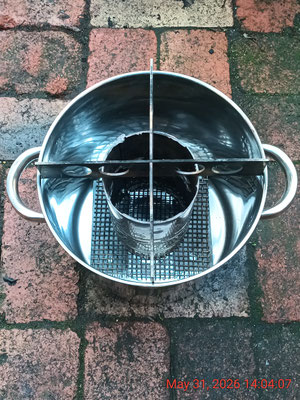


TECH SPECS
- 7.6L stainless stockpot (OTS, Anko)
- quench collector, heat shield, wind shield, plus bonus water collector eg. Water collection, dishes tub etc.
- primary air support
- 140 x 140 (5x5x1.6 aperture) 304 woven mesh square (grinded)
- commercialisation: semi-circular (2) interlocking blocks (10 high, 10 wide, 200 outer diameter, off 304 plate) + mesh circle (woven mesh, 5x5x1.6, 220 outer diameter, 304) sitting on top of the blocks (both 2D laser cut)
- burner (10,20,100,110,180) (grinded)
- 100mm/4" wide 304 chimney flue
- 10/20 primary air slots
- 90 high fuel reactor
- 100/110 secondary air slots
- 70mm chimney
- 180mm high
- burner weight: 255g
- wood pellet max capacity: 400g
- cross piece/pot stand (2D laser cut)
- Two 304 2.5x40x220 (2 interlocking pieces)
- From the 'Flat Permastove' base
- upcycled stainless steamer for '2 in 1' steamer and biochar pellet water filter
- 3L stainless billy
- 10.25" cast iron skillet
DESIGN NOTES
So, I wanted to build a TLUD with the minimum steel possible; high quality and durable stainless steel where possible; an integrated heat shield, wind shield, quench collector and water
collector; fuel efficient using wood pellets for an Oz made burner; the least manufacturing labor possible (OTS, 2D and possible 3D laser cutting); with a stable (nested) stovetop for a variety
of cookware which could extend beyond the footprint of the stovetop; a water filter integrated with a 3L billy (very popular in Oz); maximise the use case scenarios with survival at it's core;
lowest overall cost possible; stable supply chains in Oz; an acceptable volume with part nesting for potential commercialisation logistics; and, high quality biochar pellets as a byproduct of a
'Carbon negative' burn with various cascaded applications eg. water filtration->sanitation->composting->growing systems. This is probably the closest I've got so far...however, it is a
low fuel capacity TLUD which should be fine for basic survival, not an institutional burner. This testing season, I've already had a breakthrough with the Navigator Burner 4" 34cm high (see the
'Navigator Kitchen (NK) 2026' page) with a perfect 7cm chimney for 4" tube and generous burn time and flame temperature range. So, a compact Navigator 'Awesome' V3 using an OTS and cheap Queen
20L stainless bucket might be the trick which I haven't received yet and could be too top heavy. The 7.6L stockpot used for this design is straight sided for excellent stability but I didn't want
to build into larger stockpots which tend to go wider and not much higher for higher volumes. I'll make an announcement on the 'Blog' page if I have success with the 'Awesome' V3.
I hope to test the 'Adapt' V3 during June 2026, with results posted in the 'TESTING' section below.
TESTING
Burn 1
- 400g, 90 fuel height, degsC ambient temperature, m burn time, % Biochar recovery, ?good flame cap coverage
- 3L water pasteurization (71degsC):
- breakfast:
THE COMPLEX WICKED PROBLEM UNRAVELED
The world's waste problem eg. Biomass, plastic etc., treated with Pyrolysis (various methods eg. Flame Cap, TLUD, MAP), producing (bio)char, with potential post-processing, such as Flash Joule Heating (FJH) or other processes, for advanced C material possibilities, can probably solve most of the world's material problems and applications sustainably with circularity and probably C negative too (need to do a C footprint).
If a project/business is 'C negative' by producing (bio)char (or removing Carbon through other methods), then Carbon Dioxide Removal (CDR) credits can be sold via a platform on the Carbon Removal Marketplace (CRM) which increases the economic business case but shouldn't be relied on entirely for a profitable business model.
So, solved the waste problem, advanced human Civilization, built a sustainable project/business and cooled and stabilized the global climate system???
Sounds too good to be true...unless opposing forces are 'phased out', such as fossil fuels and deforestation...
'Sustainable adaptation' can be achieved with adaptive and what I call 'Appropriate Carbon Removal Technologies' (ACRT, see web page) built, adaptive systems, such as regenerative agroforestry and adaptive decision making/reasoning at all levels which should be permitted by the media...
Good leaders are able to change their mind if better solutions to problems are found.
We shouldn't be 'blind' to climate science! But, difficult to negotiate text (COP30) when so many fossil fuel exporting Countries won't divest and see a green future for all. And that's not even beginning to challenge established fossil Corporate power structures. If that's a 'thing' to worry about, which I guess it is. First things first. The climate science and ethical debate has probably won hearts and minds in many places but needs to be applied in physical reality. This could be achieved with more research, which needs to be well funded, design, development, manufacturing and practical action which feeds in to the broad agenda of 'Saving the Planet'.
In my mind, the most effective approach to build this momentum is to apply ACRT to produce biochar and transition to 'Regrowth Circular Bioeconomy'.
ENDNOTE
- Biochar applications
- if the Biochar is used for filtration of toxic wastewater, then the end C sink should be hard infrastructure eg. Charcrete, roof tiles, charclay blocks, indoor render, indoor
floors, benches et al
- if the Biochar is still non-toxic (and 'Soil Food Web' friendly) at the end of a cascade, it can be added to compost or directly into the soil for growing systems
- an example of some cascades could be
1. wastewater (storm water, mining etc.) treatment with heavy metal/dyes/antibiotics/ag chemicals removal->hard infrastructure (linear)
2. air filtration->water filtration->urine/bokashi sewage treatment->bokashi compost->growing system->biomass->harvesting->biomass waste->more biochar
(circular)