
 Permachar
Navigator Kitchen (NK) 2026
So here we are again for another season of TLUDing in the 'Navigator Kitchen' (NK) in 2026. I decided over the Summer that R&D for the NK would take priority over the other Navigator TLUDs as this would probably have the highest use case level in Australia. Since last season, there's also been a war in the Middle East predictably driving up the price of fossil fuel derived products. Until that's sorted out, and for possibly many months later, expect to pay more for everything in Australia (and in most other places too). The NK provides an alternative 'Carbon negative' energy option to LNG which may help DIYers stuck on gas, with the potential for a cottage industry to build many of these outdoor kitchens to help more people with energy bill pain. The Navigator Burners, used in the NK, will most likely use wood pellets (preferably from FSC plantation/agroforestry waste) or micro wood chips, also from biomass waste. I was able to get plantation waste based wood pellets but they don't appear to be FSC certified. I was able to get 10 15kg bags locally for testing and primary and backup cooking (and water pasteurization if I ever need it eg. adventuring, but has been brilliant for testing TLUD engineering) so it's going to be a better testing year with more wood pellets available.
So, what I've already worked out is both the 4" 304 exhaust tube burner and the 5" 304 chimney flue burner needed more updraft than what I was getting from a fuel level 20mm below the secondary air slots. I've tested them with the fuel chamber half full and successfully got a stable and hot flame with the optimal level of updraft, suitable for a range of recipes and cookware. Water pasteurization, which has previously been a focus for smaller TLUDs, will also be tested thoroughly. Both the 4" and 5" burners (and a 6" for environmental fuel) have been effectively integrated with a 20L ss bucket based system which I have previously called the 'Navigator 'Awesome' V2'. So, the same burners can be used for a semi-permanent NK stovetop or for mobile car camping situations where packing space is critical.
On to the photo gallery...

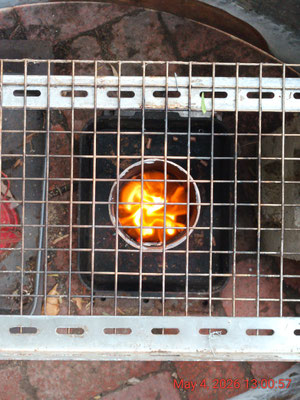


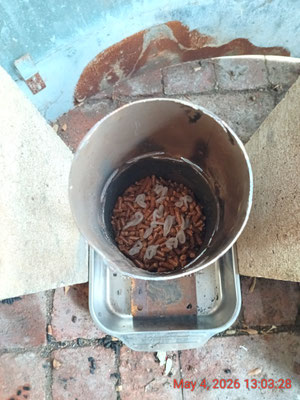
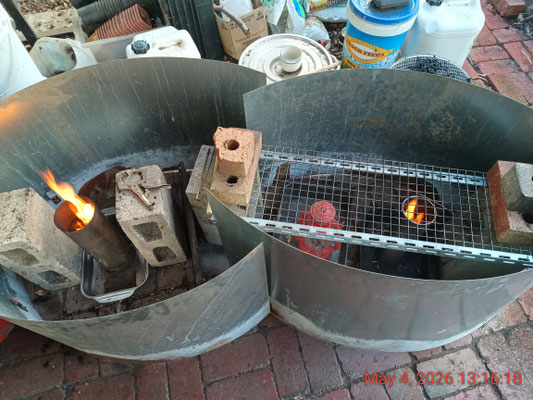
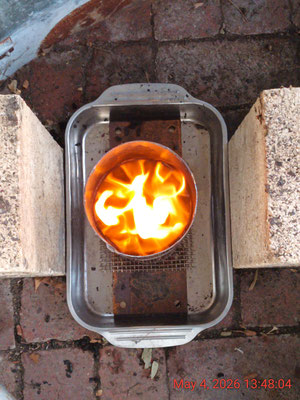
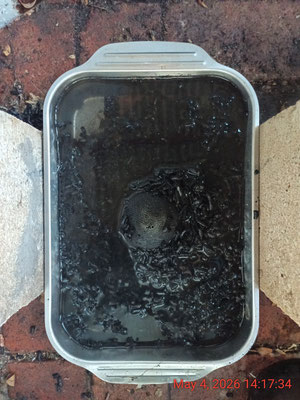
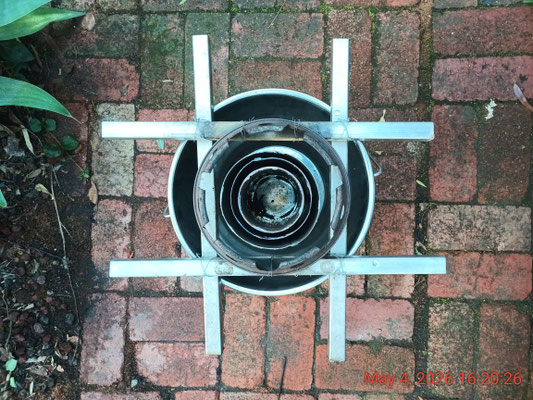
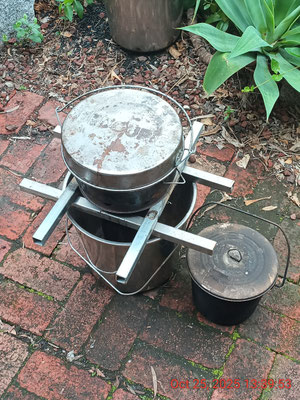

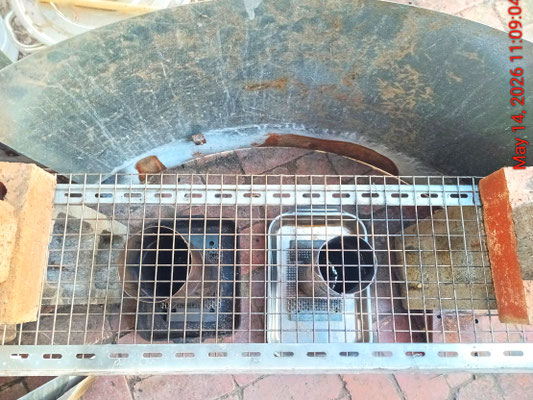
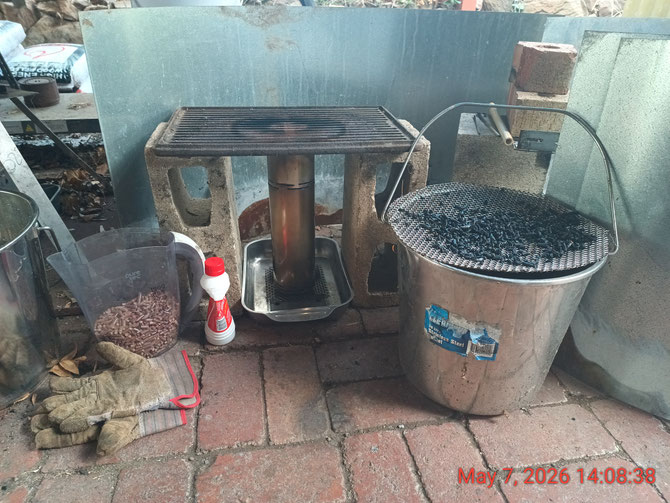
Operation (for semi-permanent installation using besser blocks and grill/mesh)
- position the burner in the centre of the mesh square, supported by 2 steel blocks, on an oven tray on a flat surface
- fill the burner with fuel eg.wood pellets, rice husk pellets, bamboo, sticks etc. up to desired level to a maximum height of 20mm below the secondary air slots
- add a circle of firelighter gel to the top of the biomass fuel 2cm in from the tube edge plus a bit in the centre (or 3 cotton wool buds soaked in kerosene)
- light the burner from the top with a wooden skewer. Add a tiny bit of gel from the fuel surface onto one end of the skewer then light it THEN light the gel on top of the fuel
- position the mild steel grill and cooking accessory eg.15L stainless stockpot on top, after 5 minutes burner startup
- ready to run without adding any additional fuel during the burn
At the end of the burn:
- flame goes out and smoke follows
- put on some leather gardening gloves (and keep them on until the water quench or soil quench has been performed)
- remove the cooking accessory
- remove the grill
1- Water quench (if enough water is available).
- Add water to bottom of the oven tray for a 'bottom quench' (to 3cm high water level which just covers the burner bottom and primary air slots)
- Add water from above the top of the burner eg.water jug, for a quench of biochar pellets until oven tray is almost full of water (mind the steam)
NOTE:The steam is good for some Biochar activation to increase surface area and surface Oxygen functional groups 'hydroxyl [ -OH ], carbonyl [ C=O ], and carboxyl [ -COOH ] or [ -C(=O)OH ] for water filtration) - lift the burner vertically eg. 20cm above the oven tray, with billy lifters/pliers/C clamp, and the biochar will fall out the bottom (may need to use a stick to push out the biochar)
- using a stick, stir the biochar into the water and there will then be a complete quench
- wait 10 minutes then, wearing leather gloves, empty the oven tray into a bucket eg. a 20L stainless one with mesh on top for separate biochar and water recovery (which could be collected for 'smoke water' to promote seedling growth)
- reposition blocks, mesh and burner on oven tray
- ready for the next burn
OR
2- Soil 'quench'/no spare water
- dig some soil and make a pile of soil near the burner before the burn
- lift the burner vertically eg.20cm above the oven tray, with billy lifters/pliers/C clamp until all the biochar and soil has fallen out the bottom (may need to use a stick to push out the biochar and soil)
- shovel soil onto the Biochar
- leave for 10 minutes
- once no smoke, empty the oven tray (or bucket) and retrieve components
- add the biochar and soil mix back into the soil hole, near the burner - the climate and microbes will love it!
- reposition blocks, mesh and burner on oven tray
- ready for the next burn
END
TESTING
-Numbers from bottom of 4" Navigator burner to top of Navigator burner
(10,20,260,270,340)
10,20, primary air slots
260, 270 secondary air slots (70 chimney sweet spot for the 4" in the 'Adapt' V2)
340 high
20 tertiary air
Height of biomass feedstock
- need to optimize eg. 210 fuel height for 50mm updraft below secondary air slots and more fuel capacity compared to V1 using exhaust tube (10,20,230,240,340)
Burn 2: 1kg, 210 fuel height, 1h 58m
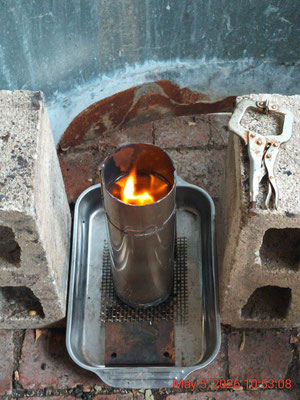
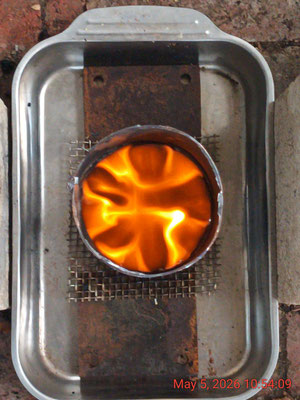
Burn 3: 600g wood pellets, 25 burns/15kg bag@$25 per bag=$1 per burn,
120mm fuel height, with cone insert, 16 degsC ambient temperature, 55m burn time,
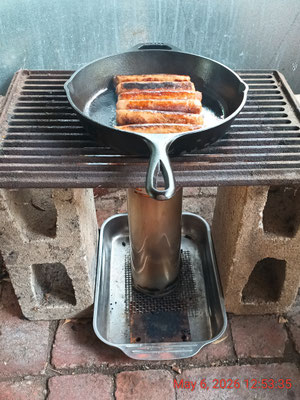
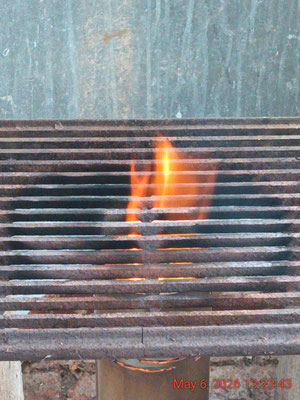
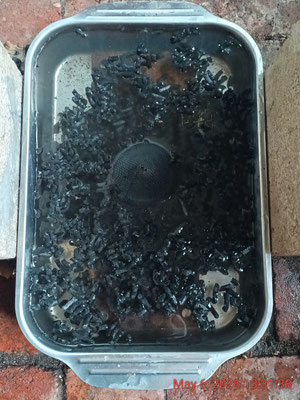
Burn 4: 600g, 120 fuel height, no cone insert, 11degsC ambient temperature, 50m burn time
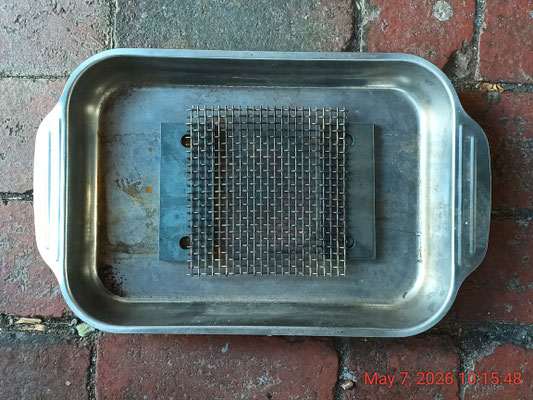
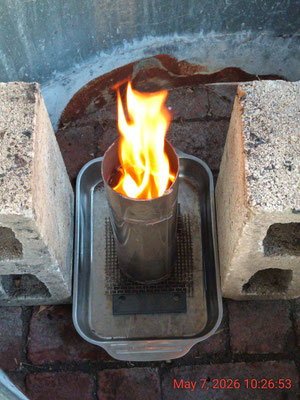
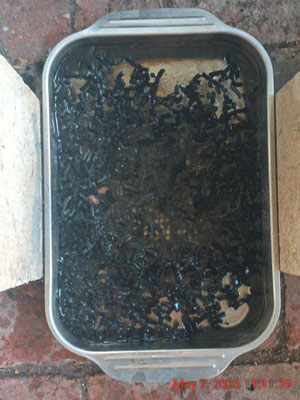
NOTES
- Bottom mesh square, 10 high (mild Steel plates on 2 sides), recommended to convert last 10% biomass into Biochar for ~100% Biochar conversion
- updraft can be optimized with feedstock height/distance between feedstock and secondary air slots
(which is less noticable with shorter burners) + chimney height (the height above the secondary air slots, which is fixed), which seems to be optimised at around 70mm for 4" burners
-
the Biochar above the pyrolytic front creates resistance to the upward flow/updraft of the wood gas
- the more updraft resistance, the lower the height and size of the flame and the cooler the burn
CONCLUSIONS
-
lower fuel weight (eg.600g, 'Burn 3'), lower fuel level/more distance below secondary air slots, more updraft, hotter flame (less fuel efficient) = shorter burn time (eg.55m, 'Burn 3')
- higher fuel weight (eg.1kg, 'Burn 2'), higher fuel level/less distance below secondary air slots, less updraft, cooler flame (more fuel efficient) = longer burn time (eg.1h58m, 'Burn 2')
-
using the above principles, the 4" Navigator Burner could be considered as a 'Four flame mode' burner:
1. Less than 600g could be used for a 'Very hot flame' which could be perfect for wok cooking
2. A 'Hot flame' using 600g wood pellets
3. A 'Cool flame' using 1kg wood pellets
4. More than 1kg...eg.1.3kg at 2cm below the secondary air slots, for a 'Very cool flame' for, say, keeping a soup warm, with well more than 2h burn time
FUTURE RESEARCH DIRECTIONS
Why use electricity (fossil fuel/renewables) for stovetop heat when heat, from biomass, can be used for stovetop heat, with biochar as a byproduct making it a Carbon negative process with possible bioelectricity cogeneration?
I'm on a mission to find low cost tech, preferably commercially available, to recover 'waste' heat from the Navigator Burners. I came across Tubular Thermo Electric Generators (TTEGS) while researching TEGs. This could be a more efficient way of capturing 'waste' heat from the tube rather than a heat exchanger above the flame with flat bottomed TEG. It would also allow burner operation while collecting heat, converting it to power and storing it in an external power bank. This is not a new idea. Biolite 2 plus does a similar thing and integrates well (and doesn't make biochar - fact check) but I'm wanting a more modular system that is also generic eg. an OTS clamp-on TTEG eg.designed for 4" or even 5" tube, charging an OTS power bank over USB. I have no intention of coupling the burners to the TTEG for electricity, eg., forced air. At it's primary level, I want the burners to be standalone systems, durable/rugged, modular, free of electronics and solid state (which the TTEGs are as well) with simple fabrication (DIY/industrial) and easy operation.
I'm an enabler playing the sustainable survival game - if it is a game, which may not be a game but essential for human progress. Fossil fuel dependency is difficult to shake. Biomass is available almost everywhere and, ergo sum, biochar will be everywhere in the future. The climate certainly needs saving to save us - and we're the only sentient beings that can save the climate, in my opinion. Every energy transaction I make changes the weather around the world. As long as there are good choices still on the table that can be made I'm not complaining too much - I mean, it's not like I'm coding AI, profiteering then escaping and digging wells though I'm not opposed to greater groundwater protection. But lets face it - in Oz, if the various Gov's valued water as a common good and a critical current and future resource, they wouldn't have gone down the path of approving large-scale, or any scale, of fracking. I have been investigating methane gas for years, off and on, and I think the fuel source has been beaten with electrification, whether it be from solar, wind or biomass 'Combined Heat and Power' (CHP) or a combination of two or all of them per energy system. Natural Gas grid peakers, turbines, stovetops and hot water systems have all been defeated with renewable alternatives. I guess there are still niches that love it and won't ever change their stripes. The only thing left to do is block expansion of the LNG industry and tax the hell out of what's left, maybe starting with 25%+ taxation of LNG export royalties (which is decoupled to the price of LNG) and use that money to build a more sustainable and fairer Nation.
May the fire burn strong in our hearts and minds!!
Stirling Engines and micro-ORC systems probably won't cut the mustard for small TLUD burners due to cost, engineering and scalability issues aka not economic. Am I missing something here? Please comment if you have better intel. TLUD burners could be scaled for micro CHP but downdraft gasifiers have so far been the only commercial options in this space. Stirling Engines (higher efficiency, higher cost per kW energy) and (micro) ORCs (lower efficiency, lower cost per kW energy) really shine with larger scale burners aka medium scale eg. PyroTower, Charcell 3, ECHO2 to large scale eg. Charcell 4 plus many more, biochar kilns. Bioelectricity here can either power the electrical components/machinery of the kiln and/or charge batteries for, eg, local households or even a small factory. The on-demand bioelectricity power at the utility scale can be viewed as complementary to big batteries, usually charged by solar, wind or both.
I'm also interested in biochar as a Carbon feedstock for C-based batteries and supercaps. The electrode argument, in my opinion, has been won by steam/KOH/KMnO4 activated bamboo, microalgae or
macroalgae biochar. Microalgae and macroalgae biochar have an additional advantage of N self-doping for unique electrical properties. In the academic paper 'Electrochemical Performance of
Nitrogen Self-Doping Carbon
Materials Prepared by Pyrolysis and Activation of Defatted Microalgae' (2023), in Nanochloropsis and Chlorella biochar, micropores peaked at 0.4nm (which is
astonishing). Carbon based electrolytes for supercaps probably need more R&D. It would be interesting to look at combinations/biocomposites with the microalgae biochar. Failing that,
'Carborane' based materials look very promising.
A 'National Pyrolysis Strategy' can use every 'waste' resource by pyrolysing it to produce (bio)char. This, in my opinion, is the key to unlocking regrowth circular bioeconomy. What could be interesting is a decentralised biomass pellet strategic reserve. I imagine that stores of pellets could be initially built around utility scale big batteries on the different grid systems. The pellets could be used to produce bioelectricity to complement the big batteries, or even Redox Flow Desalination (RFD) systems in near coastal areas, and produce biochar pellets as a byproduct for farmers or whoever else wants to buy them.
I've attached a research paper to give you an idea of what's been researched so far in the TTEG world.
No doubt there are other research papers on the topic too and more in the pipeline...
RESOURCES
https://thermoelectric-generator.com/annular-tubular-teg-maximum-power-output-of-25-watts/
https://www.psu.edu/news/research/story/form-fit-device-wraps-around-hot-surfaces-turns-wasted-heat-electricity
