
 Permachar
Microalgae Integrated Systems
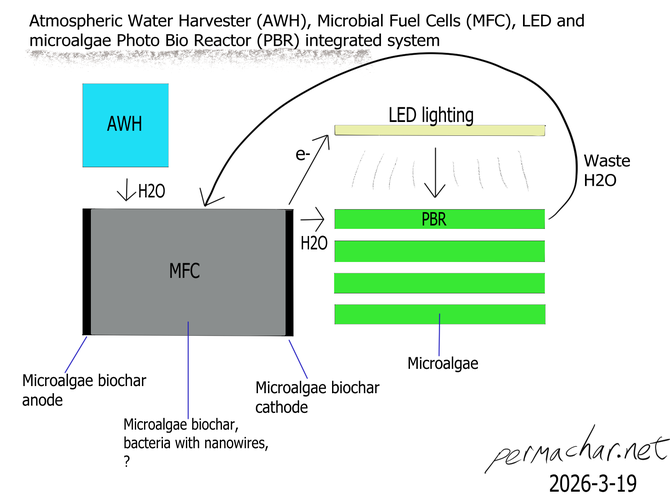
If no/limited sunshine eg. space
- MFC
- MA Biochar electrodes
- low temperature (70%)/high temperature (30%) MA Biochar + bacteria stack for anolyte (structured syntrophic consortium)
- can be used to treat additional wastewater
-
BUT complex and probably not powerful enough for what's needed
- could possibly trickle charge a DC battery, DC output 12/24V

If sunshine, optional AC input from a larger solar system or mains connection
- Solar generator eg. Voltx S2200 pro (2)
- one charging (solar/biomass)
- one discharging (24V LEDs, 240V AWH)
- OR, hot swappable system eg. Airbase
- 2 x 600W PV panels (solar)
AND - Navigator 'Genie' TLUD (biomass)
- can be prototyped with wood pellets
- 24V output from SE
- LED lighting
- AWH machine eg. Mobile Box 25L (480W peak (?AC input), Or, MA Biochar AWH panels (concept stage))
- PBR
- pelletiser eg. Millers Falls or larger
NOTES
- Most of the modules are 'Off the shelf' (OTS)
- A larger scale system eg. using MA 'raceway ponds' (or even round aquaculture ponds with a central paddle) could intregrate lipid extraction from harvested MA for biofuels producing waste MA biomass that can also be pelletised and used in possible multiple 'Genie' modules or a new MA pellet kiln design for bioelectricity and biochar (anyone wanna fund me?)
- Cyanobacteria possible too, though probably only useful for biomass fuel pellets->bioelectricity + biochar pellets->air filtration->water filtration->growing systems->sanitation->plants eg. Basella alba (Malabar spinach)
POSSIBLE TECH SPECS FOR A MEDIUM TO LARGE SCALE MICROALGAE PELLET KILN AND BIOREFINERY
Microalgae strain agnostic/programmable for the machine learned products you want from an unlimited number of machine learned/automated classified endemic strains
- Open source
- Stationary
- Modular
- Light as possible
- Transportable in a shipping container eg.40 foot
- Biomass starter
- Biomass pellets from MA waste biomass
- Process heat by-product from Pyrolysis for dewatering of the microalgae (could possibly condensate the water for adding to the quenching troughs)
- Energy efficient/self sustaining/self-powered
- Fossil free
- Self-powered with a heat exchanger and ORC/TASE
- Continuous: Can be augur fed (only moving part)
- Augur made from steel
- augur powered from an electric engine coupled to an ORC/TASE with heat exchanger
- additional bioelectricity could charge a big battery (eg.with additional solar PV panel input) or used directly for other powered applications eg. data centre, factory floor etc.
- Variables: Pyrolysis temperature, moisture content, residence time controlled by augur speed
- Different stages/batches of continuous pyrolysis at different temperatures for fractionating chemicals eg. lipids, starch, protein, hydrocarbons etc. The temperature changes the ratio of the
products of pyrolysis. Could be known as a 'multi-stage rotary kiln'.
- Uses reusable green catalysts, possibly different at each temperature stage
- Airflow with temperature measurement (high grade ?inconel thermocouples)
- Simple & high grade electronics connected to a RPi5 with 10" touchscreen interface running CircuitPython on RPi OS (enclosed in a weather proofed box)
- 3mm HW350 steel housing - Can be left outside with no canopy
- Fast startup time and can be shut down anytime for maintenance
- Standalone system. Doesn't need to Integrate with existing infrastructure other than a separate water supply for quenching, which could source water from the atmosphere (AWH) or use desalinated
water (see below)
- Australian manufactured
- ?150k+
- ?biochar kg/h
- Final product after pyrolysis, Biochar (with NPKS etc.), transferred to freshwater troughs (using desalinated seawater via University of Tokyo's nano fluorine ring membranes) for
quenching
- pH balancing in troughs, once quench liquid has cooled microbes added for a BMC product added to compost for agriculture and horticulture
- Biochar earns CDR credits from a Carbon Removal Marketplace (CRM) platform
-In the future, some parts eg.augur, could be possibly 3D printed by a Rosotics/? 3D printer
What do you think? Please use the contact form on the 'Contact' page if you wish to comment or collaborate
