
 Permachar
The 'Permafilter 20L' - a gravity fed biochar water filtration system
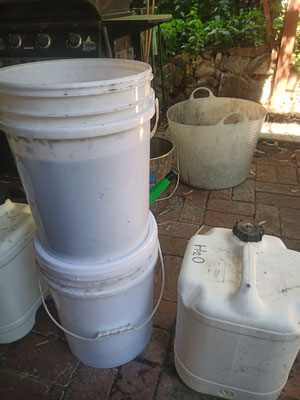
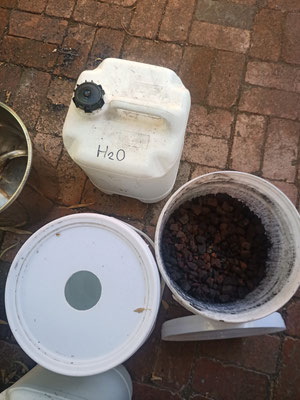
Permafilter 20L
Built with 2 x 20 Litre food grade plastic buckets with lids (which may or may not be BPA free). Water is added to the top bucket and filtered via gravity through stones eg.scoria ->biochar pellets->finely milled biochar pellets->cheesecloth->dripped through a drilled hole pattern within a bottom central and circular footprint. This drilled area matches the diameter of a single hole sawed into the lid of the bottom bucket. In my system, it takes about 45 minutes for filtration. This time will vary from system to system.
Operation
1- Filter
- Biochar pellets can be used from TLUD stoves such as the Navigator 'Adapt' V2, Navigator Burner (in the 'Navigator Kitchen'), Navigator 'Awesome' V2 and more...
- removes POPs
- removes microplastics
- removes heavy metals, dyes, antibiotics etc.
- spent/replaced biochar can be added with bokashi to 'Humanure' toilets and/or a piss bucket
2- Pasteurize the water using a TLUD (arguably up to 71 degrees Celsius)
- kills bacteria, viruses and protozoa
- boils off some VOCs
- Drink (potable water)
The 'Permafilter 3 bucket' - another, but smaller, gravity fed biochar water filtration system
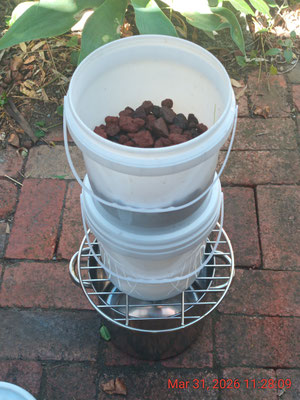
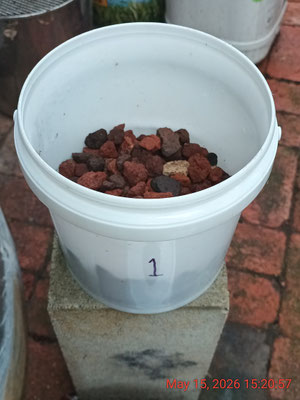
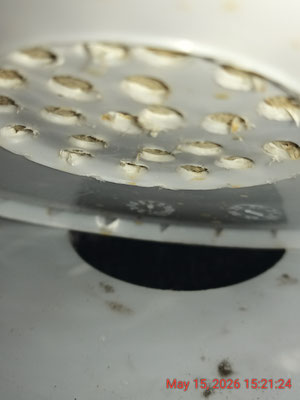

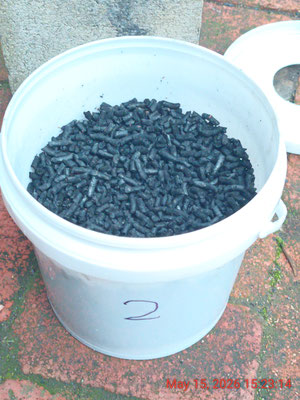
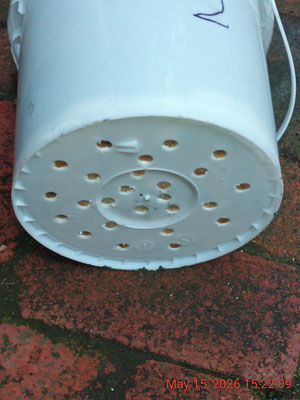
Permafilter 3 bucket
Another possible design, also gravity fed using the same engineering as the 20L, uses two food grade 5 litre (or possibly 10 litre) buckets and a 7.6L stainless stockpot with top grill, which I call the 'Permafilter 3 bucket' and is easier maintenance for replacing the biochar found only in Bucket 2, compared to the 'Permafilter 20L' which layers all the filtration media within the top bucket:
Bucket 1 (top) - stones->sand->cheesecloth;
Bucket 2 (middle) - unmilled biochar pellets->milled biochar pellets->cheesecloth;
Bucket 3 (7.6L stockpot and grill) (bottom) - water collection
The Biochar pellets from the stoves eg.Navigator 'Hormuz' V1 TLUD (see the 'Simple Survival System' page) can be collected and used to replace the Biochar pellets (unmilled + milled) in 'Bucket 2' in the 'Permafilter 3 bucket' as needed BUT
A big question is, how do you know when to safely replace the biochar pellets?
Ideally, you could send water samples to a lab for bacteria, virus, protozoa and chemical testing. But, this is impractical for most of the world though not impossible. The initial water quality before filtration would be a major factor. It also depends on how much water you are filtering. It also depends on the volume of biochar pellets produced to meet supply for the filter. This needs to be scienced out. If a calculation could be made from initial water quality testing, then a timing regime could be adopted for the most efficient time to replace the biochar pellets in the filter. Anyone interested? This could be a great PhD for someone, or even for a postdoctoral researcher in water quality testing.
I'm aiming to complete basic testing, optimisation and documentation (on this page) of the 'Permafilter 3 bucket' by 7/2026