
 Permachar
Why TLUDs?
- cooking
- WASH
- water pasteurization with optional Biochar water filtration
- sanitation
- hygiene
= Improve public and individual health
- biochar, via pyrolysis of biomass fuel (cogeneration): C removal/C negative
= cool the global climate system - other applications (see end of page)
= Reduce poverty and increase physical security
4 main Navigator systems
- Burner with semi-permanent or permanent stovetop
- Navigator Kitchen
- Mesh and besser block stovetop
- super stable
- Universal Pot Stand (UPS)
- a little unstable
- Mesh and besser block stovetop
- Navigator Kitchen
- Integrated bucket/stockpot, burner and stovetop system
- Awesome V1, V2, V3 (under R&D)
- Hormuz V1
- Adapt V1, V2, V3 (under R&D)
- Integrated agnostic quench collector, burner, stovetop cross piece and heat shield system
- Backup V1, V2
- Light V1, V2
- Single piece burner (minimalist)
- Backup V3
- Turret V1, Milo Tin V1
Prior technology
- 3D printed single piece burner
- Tread Lightly
- Burner, cross piece and separate quench bucket
- Permastove V3
- flat packed TLUD
- Flat Permastove
- retrofitted berko
- Permastove V1
- tipping TLUD with separate pot stand and separate quench bucket
- Champion 2008 (Dr TLUD)
Three main materials for burners
1. 304 chimney flue, 1.2m length (Oz rolled)
1. 4"
2. 5"
3. 6"
2. 1.6mm 304 exhaust tube, 1m length (imported)
1. 4"
2. 5"
3. 6"
3. 1.6mm 304 tube, 6m lengths (imported)
- 4" is best for smaller stoves and cooler burners eg. Navigator 'Backup' V2, 'Light' V2, 'Navigator Burner'
- 5" is best for fast water pasteurization and accessories needing a hotter flame eg. 'Navigator Burner', Navigator 'Awesome' V2
- 6" is best for environmental fuel eg. Navigator 'Environmentalist' V3
Also - Chimney flue is lighter weight/less steel and easier to grind than exhaust tube.
- Exhaust tube will last for longer than chimney flue, but may not be an issue if the TLUD is only used occasionally.
- 6m length tube best for commercial operations that can be 3D tube laser cut
Other materials
- 20L oil drums
- 20L SS buckets
- Biochar and smoke water collection
- Navigator 'Awesome' V2 heat and wind shield/pot stand/quench water collector/water carrier from source
- 12L SS buckets
- 7.6L SS stockpots
Essential tools
- 100mm grinder eg. A corded Makita plus 100 x 2.5 x 16 Makita discs
- kango 2nd cut file
- woodcraft vice
PPE
- welders helmet with 'Grind' option (unpowered)
- leather gloves
- cotton clothing
Key findings from Navigator tube and slot system
- based on core TLUD design principles of primary and secondary air, adapted for tube
- dual primary air slots rows are needed regardless of tube thickness, diameter or height. In the case of wood pellets, biochar recovery varies from 90-100%, as sometimes some wood pellets at the bottom and centre of the tube don't pyrolyse but can be avoided with a ss bottom mesh and block support
- secondary air slots can be single row or dual row.
- single row for small stoves & 6" environmental fuel burner (cooler and more fuel efficient)
- dual row for bigger stoves and burners (hotter for water pasteurization but a single row for a 4" burner is cooler for slow cooking)
- a ratio of 2:3 (height of secondary air slots to overall height of stove/burner) generally works well but this has been tuned to more specific ratios for better updraft performance...
- updraft, which is affected by chimney height: tube diameter ratio (4" (7cm chimney) and 5" (10cm chimney)) AND distance between top of fuel and bottom row of secondary air slots (more distance = more updraft)
-
there's a 'peak synergy' configuration for a stable flame cap in every Navigator Burner
- alternating slots for dual rows work best
- fuel eg. Wood pellets, vertically stacked sticks, up to 2cm below lower secondary air slots row at maximum capacity
- needs a moisture content (MC) below 15% for almost completely clean emissions eg. almost zero CH4 emissions
- Forced Air/Fan Assisted operation is not needed and not built into the system. The system is completely solid state with no moving parts or electronics. Electronic failures are avoided. Simpler supply chains too
Pot stands used in different designs (plus tertiary air)
1. 220 x 40 2.5mm 304 cross piece (originally used as a primary air mesh support in the Flat Permastove), used for the 'Backup' V2, 'Versatile'
2. 130 x 30 1mm 304 cross piece (originally used in the Permastove V4), for the 'Light'' V2
3. Rectangular turret on top of smaller stoves, for the 'Milo tin' (see blog)
4. 1.6mm 5x5 304 woven mesh plus wok ring (optional modding), for the 'Awesome' V2 and 'Environmentalist' V3
5. 1" x 500 304 square tube (x2, off 1m length), positioned parallel on eg. 20L oil drums or 20L SS bucket, 'Awesome' V2 and 'Environmentalist' V2 (can also add another layer of 1" x 500 square
tube for additional height)
6. Woven mesh + modded wok ring wired to 2 x square tube lengths, for the 'Awesome' V2 and 'Environmentalist' V2
7. Universal Pot Stand (UPS), for the 4" and 5" 'Navigator Burner'
8. 1" 2mm 304 mesh, reinforced with slotted galv angle (wired) on the back edge, supported on besser blocks at either end, for the 4", 5" and 6" 'Navigator Burner'
Cookware
- 2L/3L/5L ss billy
- 10L/15L SS stockpot (with possible ceramic fiber thermal insulation)
- 'Bedourie' 8"/10"/12" heavy gauge spun Carbon steel pot and lid (doubles as a frypan)
- cast iron skillet (very stable stovetop or oven (see below)/ss frypan
- wok
Other applications
- 'Bakerstone' pizza oven (5" 304 chimney flue burner heating from below)
- cast iron BBQ grill (5" 304 chimney flue burner heating from below)
- 'Gordian Knot' oven and hot plate (?4"/5" 304 chimney flue burner heating from below)
- hot water system
- urn
- bioelectricity eg.Thermoelectric Generators (TEGs) and Stirling (heat) Engines
- high surface area Biochar for water filtration, Atmospheric Water Harvesting (AWH), battery anodes et al
Navigator '3 in 1' TLUD institutional system
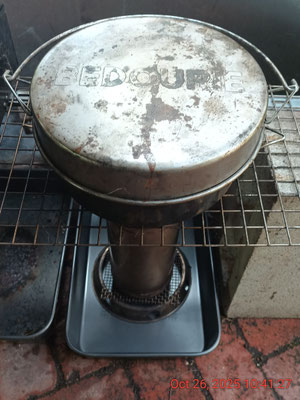

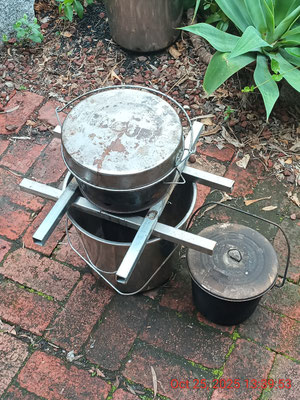
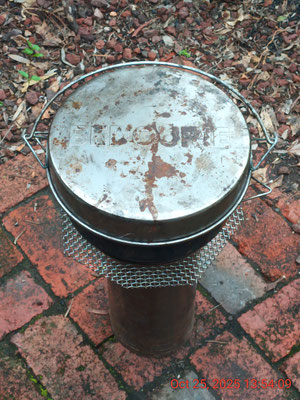
The Navigator Burners can be used with at least 3 different stovetops:
- The 'Navigator Kitchen' (4", 5" and 6") with 1" mesh, slotted angle and besser block stovetop
- The Navigator 'Awesome' V2 (4", 5" and 6") with square tube lattice and wok ring stovetop
- The Navigator 'Environmentalist' V3 (6") with mesh and wok ring stovetop
Navigator TLUD stoves
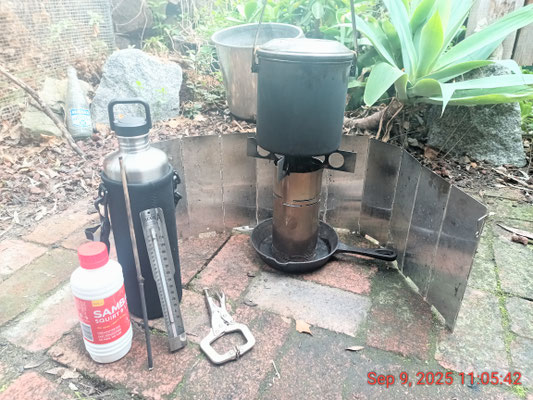
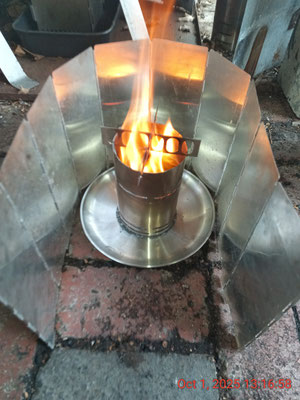
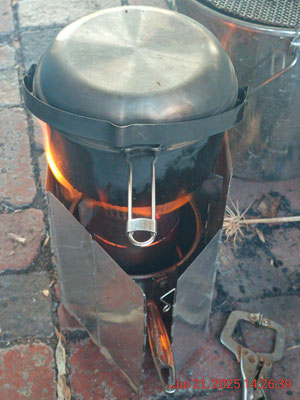

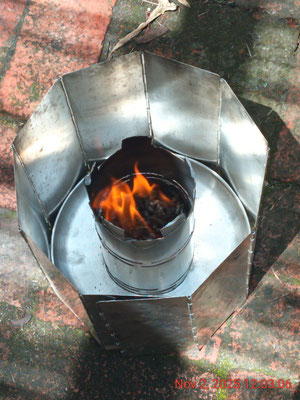
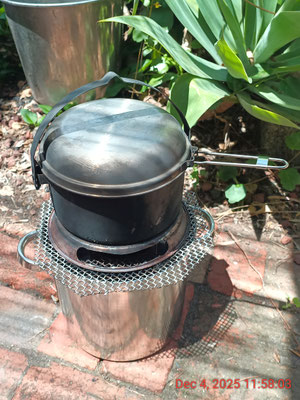
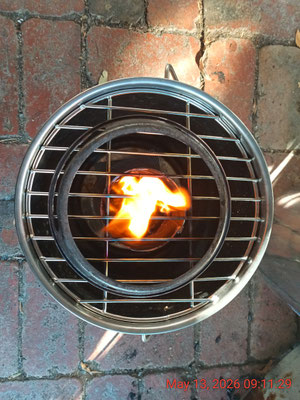

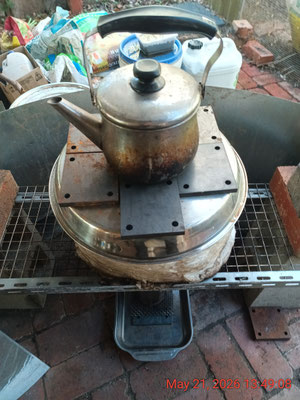

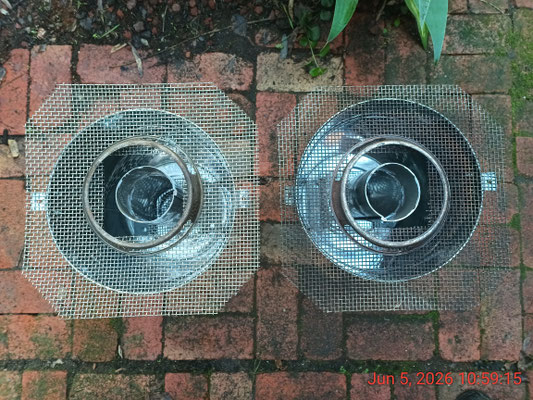
11 different stove configurations so far and counting...