
 Permachar
I'm imagining a future where machines, tools and devices can be 'Solid state' engineered using a Carbon based (and Carbon negative) electrochemistry that quickly charges from renewables eg.solar, stores a large amount of charge/energy with long duration and can be tuned to discharge power for a given application (eg. big batteries, EVs) or for various applications (in the case of a power bank/solar battery). This could be the most complex undertaking in human history to 'phase out' fossil fuel. I studied Carbon materials papers for years and to be honest, my mind is overloaded with research but prepared myself for AI intel scrambling and hallucinations. I keep on reminding myself to go back to the 'first principles' of a 'good' battery design. This blog is as far as I have got in this intellectually rewarding but 'draining' and 'money poor' R&D area. With supportive Governments, academia and industry the energy problem could turn on a dime in the Planet's favour. The 'Great acceleration' is happening. It could be called a 'Carbon materials revolution'. Maybe the next generation of researchers and designers and builders and business people can lock it all on and create jobs and wealth and further the human project for a more sustainable and advanced Planet?
***
Here's a great value add for biochar to think about...
Biomass waste streams ->bioelectricity biochar kiln->bioelectricity (eg. complementary to big batteries) + Biochar->C feedstock for C based Solid State Batteries (SSBs, from electronic devices to portable power banks to solar generators to EV batteries and utility scale big batteries) and supercaps
In my opinion, it's a bioelectricity biochar kiln, Carbon-based battery/supercap 'Carbon electrochemistry', sustainable biomass waste stream, supply chain and logistics problem.
An idea for a bioelectricity biochar kiln is as follows:
Gallium Nitride amplifiers (built from 'solid state' GaN transistors) used for a continuous Microwave Assisted Pyrolysis (GaN MAP) biochar kiln (standalone modules), co-located near a big battery
at an energy farm:
- on-board kiln battery (circuit 1, that can switch to circuit 2 battery when discharged to 20%)->powers MAP for different feedstocks eg. dried and chipped bamboo culm waste (with ideally 1
degrees Celsius granular temperature control for high biochar tunability per energy storage application)->biochar and syngas/flame->Stirling engine(s) eg. Frauscher Motors G70/G80
series->power to the on-board kiln battery (circuit 2, that can switch to circuit 1 when charged to 85%) + excess power to big battery at the energy farm (kiln is switched on for on-demand
(instant startup time) 24/7 dispatchable power for the big battery as needed)
The Carbon-based battery/supercap 'Carbon electrochemistry' is probably still mainly experimental but with an emerging and interested academic and industry community. How long will biochar C-based feedstocks last? For the 'Inertinite Benchmark', temperature is directly proportional to 'Random Reflectance' (Ro). If Ro of biochar is >2% the biochar half life is 100 million years (for essentially permanent C removal). The ideal temperature for desirable levels of graphitization (phase change) varies with the feedstock and catalyst used eg. steam activated bamboo biochar from a previous batch, which increases MAP energy efficiency by lowering the temperature for graphitization. According to academic 'Research' on perplexity.ai, there is 'no direct research' on "GaN Microwave Assisted Pyrolysis" temperature for bamboo graphitization. Temperature also relates to biochar surface area (affects electric double-layer capacitance (EDLC)), energy storage stability/degradation rate (eg. a 'Metal Organic Framework', MOF, built around a 3D biochar matrix where stability of C in the matrix, related to pyrolysis temperature and arguably phytoliths, is probably key to the MOF stability) and probably more besides. Ideally, bamboo culm waste (possibly including leaf litter for more Si), if available, could be dried and chipped, pyrolysed then steam activated. The electrical properties of bamboo eg. Moso (Phyllostachys edulis), are generally excellent for energy storage and 'electrical conductivity' (EC) according to my research, eg. high density of cellulose nanocrystals (CNCs), compared to other bamboos, which can be graphitized during higher temperature pyrolysis to increase EC, also improved with conductive pathways along vascular bundles etc. What is needed is research using GaN MAP tech to determine an optimal Moso biochar C feedstock for a given application using a standard moisture content (MC) of the biomass (before pyrolysis) and standard pyrolysis heating rate (degsC/minute) and highest treatment temperature (HTT) of pyrolysis (which is possible with granular GaN MAP temperature control). In other words, I believe it's a dance between surface area and graphitization attributes, determined by pyrolysis heating rate and HTT, for an optimal balance of storage capacity (EDLC and pseudocapacitance of Mn oxide redox reactions) and EC, which will be different for anodes, battery electrolytes and supercaps. The post-pyrolysis material also needs to be suitable for activation, such as steam (where most of the research is focused), KOH (less clean and less research) or other activation strategies.
Moso also grows in a number of Countries (reasonably 'Earth abundant') and is the world's top economic bamboo species.
The 'Earth abundant' Manganese (Mn), with high redox potential for electron exchange, is exciting too, for eg., a steam activated Moso biochar C based Mn MOF, using Carbon-Oxygen-Metal bonds. There are more Oxygen bonding sites with post-pyrolysis steam activation (as well as higher surface area too). The Mn probably gets the lions share of electron exchange in the material. Biochar also has additional functional groups for additional electron exchange sites and some synergistic effects. Possible ceramic insulation, for the battery (or even supercap) electrolytes. Anodes are also a possible application for the material. 3D printing is also a possibility.
I would call a sustainable biomass waste stream a combination of sustainable growing systems producing the biomass waste and a stable supply of biomass waste from those systems for chips/pellets etc. used in the bioelectricity biochar kilns.
In terms of supply chains and logistics, I imagine that if the existing natural gas peakers were replaced with bioelectricity biochar kilns at big battery sites/energy farms (with either wind, solar or both as renewable energy input), there will be a distributed and variable supply of biochar. If battery/supercap production was positioned in large central regional locations near these energy farms, the logistics C footprint and time required for moving the biochar to the battery factories would be decreased. Potentially, a hedge/buffer of biochar could be built at the factories to ensure a stable supply of biochar for battery production.
Alternatively - the bioelectricity biochar kilns could directly power the battery/supercap factories, with maybe a small complementary battery and wind/solar system installed, and supply the
factory with (bamboo) biochar with a negligible logistics C footprint of moving the biochar to the production line.
I'm confident the demand will be there for the associated applications but not necessarily the investment - yet. Australia has a 'Battery Industry Strategy' based in Queensland that is using
National suppliers. I would argue that any suitable Moso growing region, using the self-powered factory idea above, is a potential site for a C based energy storage manufacturing pilot
project once the science and engineering have been proven in a University eg.UQ, which could access Moso in southern QLD. A miniature land-based GaN MAP system engineered by vowasa.com could be
possibly bought and used at the University for prototyping the material. Access to Australian Mn is probably OK around the Country. Organic linkers for the Mn shouldn't be a problem either.
I should also mention that my 'New material' idea I blogged about on the 29/10/2021 speculating a direct capture and storage of solar energy by 'solar nanocrystals' could work, has now been possibly solved with 'Carbon nitrides' (possibly using Moso biochar as a C feedstock). Smartphones and tablets could really benefit here though the charge capacity is not there yet. If you're studying Carbon electrochemistry and looking for a PhD there might be an opportunity in this project at the University of Queensland though I'm not sure if they are looking at 'Carbon nitrides' or other Carbon structures:
https://aibn.uq.edu.au/study/designing-solar-rechargeable-battery-system-efficient-solar-energy-storage
Back to the topic...
Alternatively, there's another 'running' hypothesis that I'd like to test. The 'Flame Cap 'Algorithm' V3 Panel Kiln' (see web page above) could be possibly used to produce energy storage grade biochar Carbon feedstock once again using Moso bamboo. The kiln could be used for bamboo waste or whole culms, in a scenario of a dedicated crop/plantation, with minimal feedstock preparation due to the kiln's expandable length which will accept the entire length of a culm/culms.
The HTT would be more variable than GaN MAP due to differences in temperature of the flame cap as the layers build up (so less precise tunability) but maybe it will just result in a performance drop of the energy storage capacity and EC but could still be a highly functional energy storage material.
The moisture content can still be standardised (using an MC probe to check the MC).
The 'Algorithm' V3 would also be far more affordable than the GaN MAP and break the potential dependency on GaN IP based in one US company (rfhic.com). Bioelectricity via cogeneration could
be engineered (though I'm not sure how to do it yet).
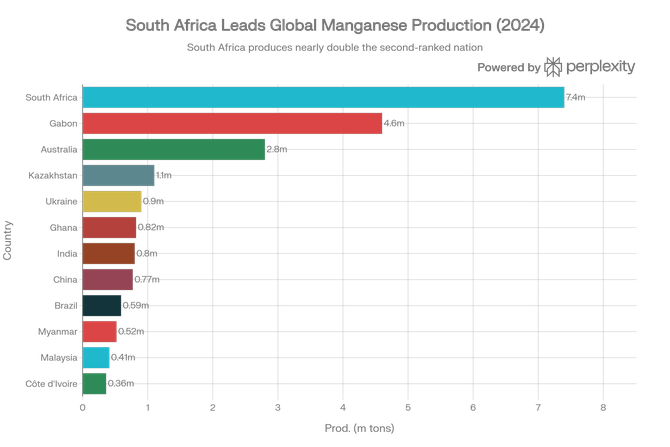
This data could be a bit scrambled but gives you an idea.
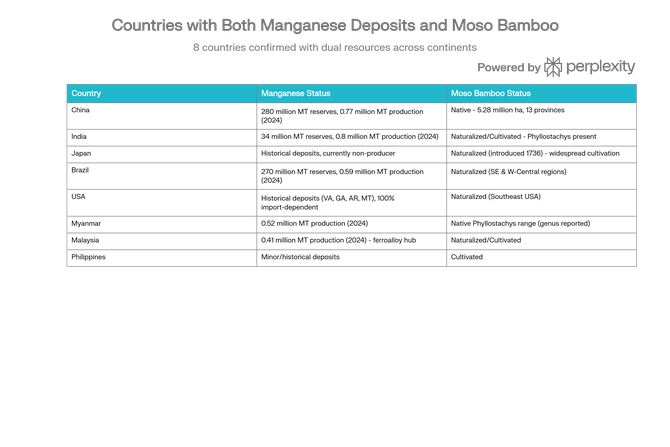
I would add Australia to the above list too with documented nurseries selling Moso and growth performance intel available. perplexity's accuracy is a little unreliable..best to follow sources and cross-reference where needed!
Here's some botanical information from a Columbian operation:
https://www.guaduabamboo.com/blog/phyllostachys-edulis
I would also recommend investigating the 'economic botany of Moso' - a fascinating plant with a long history of cultivation! Much to still learn.
The 'Steam activated Moso biochar C based Mn MOF' could be the biggest bet in energy transition history.
Why not take a punt? (and please get in touch if you're interested)

Write a comment